
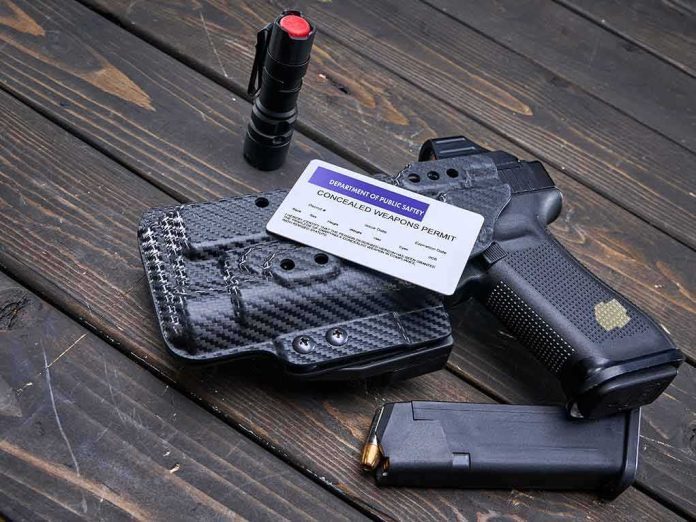
The Supreme Court refused to hear a Georgia truck driver’s challenge to Minnesota’s refusal to honor his Georgia and Florida handgun carry permits on Monday, October 5. Minnesota honors a permit only from a state whose permit rules are similar to its own, and it says Georgia’s and Florida’s are not. So the driver still has to unload his handgun and put it in a closed case before he crosses the Minnesota line.
Story Highlights
- The justices turned away Johnson v. Jacobson without comment, and no justice noted a dissent.
- Jeffrey M. Johnson Sr., a long-haul trucker from Georgia, holds carry permits from Georgia and Florida.
- Minnesota does not honor either permit because it says those states’ rules are not similar to its own.
- The lower court ruling for Minnesota stays in place, and so does the state’s permit law.
What The Court Did
The case appeared on the Court’s order list under “certiorari denied.” That is the legal term for the Court declining to hear a case. When that happens, the lower court’s ruling stands. The justices gave no reason. A refusal like this is not a ruling on who was right, and it sets no rule for the rest of the country.
The man who brought the case is Jeffrey M. Johnson Sr., a long-haul truck driver from Georgia who drives through Minnesota several times a year. He sued Bob Jacobson, the commissioner of the Minnesota Department of Public Safety, the agency that decides which states’ permits Minnesota accepts. His lawyers are with the Liberty Justice Center, a nonprofit law firm that takes on constitutional cases.
Why Minnesota Says No
Minnesota requires a permit to carry a handgun in public. It honors a permit from another state only when that state’s permit rules are similar to Minnesota’s. This kind of deal, where one state honors another state’s permit, is called reciprocity. Georgia and Florida are not on Minnesota’s list, so Johnson’s two permits do not count there.
That leaves him two choices. He can apply for a separate Minnesota permit, which the state offers to people who live elsewhere through its county sheriffs. Or he can do what his court filing describes: unload the handgun and secure it in a closed and fastened case before he enters the state. Johnson said in his lawsuit that he wants to carry for protection because truck drivers are often the targets of violent crime.
What The Lower Courts Held
Johnson sued in January 2025, arguing that Minnesota’s rule violates the Second Amendment, the part of the Constitution that protects the right to keep and bear arms. U.S. District Judge John Tunheim dismissed the case in September 2025.
Johnson appealed to the Eighth Circuit, the federal appeals court that covers Minnesota and six nearby states. On May 26, 2026, a three-judge panel ruled for Minnesota. Judge L. Steven Grasz wrote that the reciprocity law “merely creates an exemption from the permitting process” and “does not restrict any arms-bearing conduct.” In plain words, the court said honoring another state’s permit is a favor Minnesota may grant, not something the Constitution requires.
Johnson’s lawyers asked the Supreme Court to step in on August 24, 2026. Their petition said, “No matter how many times an ordinary law-abiding citizen proves his worth through a state’s firearm licensing process, another state can force him to do it again before exercising his constitutional right to bear arms.”
What Stays In Place For Gun Owners
The Eighth Circuit ruling stands, and Minnesota’s law does not change. A carry permit still stops at the border of any state that does not honor it. Each state keeps its own list, and the lists differ. A permit holder who drives across state lines needs to check the rules of every state on the route before leaving home.
The Court is still weighing other Second Amendment cases, including challenges to limits on magazine size and to waiting periods for gun purchases. The justices next meet to consider cases on Friday, October 9.
Sources:
ammoland.com, ground.news, supremecourt.gov, reason.com, libertyjusticecenter.org