

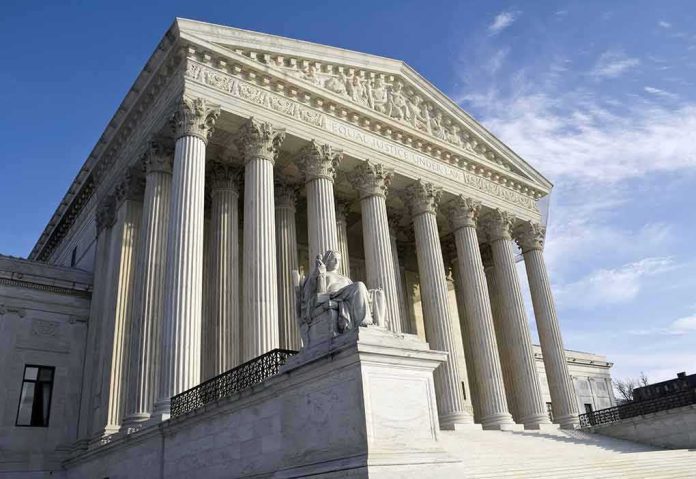
Two brothers walked into Tri County Middle School in Michigan in 2022 wearing sweatshirts their mother had given them as Christmas gifts. One boy was in eighth grade and the other in sixth. Across the front of each were three words: “Let’s Go Brandon.” Each boy was told to take his sweatshirt off, and the Supreme Court has now let that order stand.
Story Snapshot
- On Monday, October 5, the Supreme Court refused to hear the family’s appeal, so the ruling for the school district stays in place.
- A teacher and an assistant principal, in separate incidents, told the two brothers to remove the sweatshirts in 2022.
- The lower court said the school could ban the phrase because it stands in for a curse aimed at then-President Joe Biden.
- The family’s lawyers said the words contain no profanity and are political speech.
- The appeals court ruling remains the rule for public schools in Michigan, Ohio, Kentucky and Tennessee.
The Day The Sweatshirts Came Off
The reason given was the slogan itself. School officials said the phrase is a stand-in for an obscene insult against the president, and that a message with a vulgar meaning does not belong in a middle school, even when it is about politics. The boys are identified only by their initials in court papers.
Their mother saw it differently. She sued the district in 2023, saying the school had violated her sons’ First Amendment rights, the part of the Constitution that protects free speech. According to reports, some students at the school wore “Make America Great Again” gear and other clothing supporting President Trump. The family is represented by the Foundation for Individual Rights and Expression, a free speech group.
What The Supreme Court Did
The justices declined to take the case. When the Supreme Court declines to hear an appeal, it does not rule on who was right. It simply leaves the last ruling in place. Here that is a decision from the Sixth Circuit Court of Appeals, the federal court one step below the Supreme Court that reviews cases from four states. A federal trial judge had ruled for the school district first, and a divided panel of Sixth Circuit judges agreed.
The appeals court’s reasoning was plain. Because “Let’s Go Brandon” is widely understood as a polite cover for a profanity, a school may treat it the way it treats the profanity. Schools have had that power over vulgar speech since a 1986 Supreme Court case, Bethel School District v. Fraser, which said a school can punish lewd or vulgar student speech without showing that it disrupted class.
What It Leaves In Place For Schools
The Sixth Circuit covers Michigan, Ohio, Kentucky and Tennessee. In those four states, the ruling is now settled law: a principal may order a student to remove clothing with a coded phrase that officials reasonably read as vulgar, even when the message is political. The Supreme Court’s refusal sets no rule for the rest of the country, so courts in other states remain free to decide a similar case differently.
For a parent in those four states, the practical meaning is simple. A child’s political shirt is still protected under a 1969 case, Tinker v. Des Moines, which upheld students who wore black armbands to protest the Vietnam War. That protection ends where a school can reasonably say the words carry a vulgar meaning, and the school gets to make the first call.
Two Sides Of The Argument
The family’s lawyers told the justices the ruling “wrongly gives school officials wide latitude to squelch political speech based on their personal ideas of what is vulgar.” Their point was that the three words on the sweatshirts contain no curse word at all.
The school district answered that “messages with lewd implications have no place in school, even if they touch on political topics.”
The slogan itself dates to a 2021 NASCAR race. A crowd was chanting an obscenity about Biden while a sports reporter interviewed a driver named Brandon Brown. The reporter suggested the crowd was cheering “Let’s go, Brandon,” and the phrase quickly spread among the president’s critics as a way to say the same thing without the curse.
Sources:
keyt.com, thehill.com, law360.com, supremecourt.gov, casemine.com