

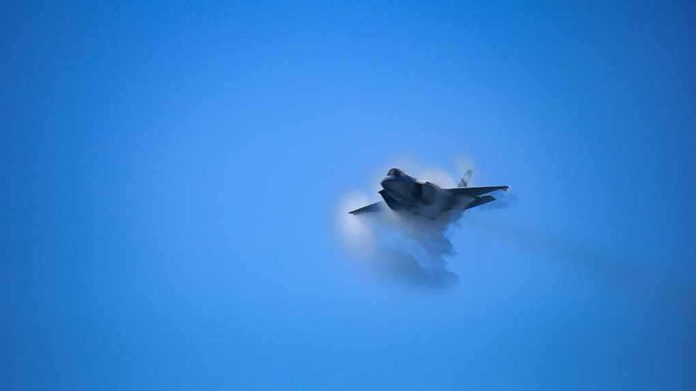
An American fighter jet has flown faster than the speed of sound for two decades without ever touching its afterburner, and the engine behind that trick just crossed one million flight hours.
Quick Take
- The F-22 Raptor cruises above Mach 1.5 without lighting its afterburner, a feat the Air Force calls supercruise.
- Each of its two Pratt & Whitney F119-PW-100 engines produces about 35,000 pounds of thrust.
- Pratt & Whitney announced the F119 fleet passed one million engine flight hours on June 30, 2026.
- The last F119 engine rolled off the production line back in 2013, yet the fleet keeps flying.
A Milestone Two Decades in the Making
Pratt & Whitney, an RTX business, announced on June 30, 2026, that its F119 engine had surpassed one million engine flight hours powering the Lockheed Martin F-22 Raptor. No other fighter engine maker has hit that mark. The milestone caps roughly two decades of service for an engine designed in the 1990s and built for a jet that entered service in 2005.
The timing matters. The achievement lands just as the Air Force moves toward its next stealth fighter, the Boeing-built F-47 under the Next Generation Air Dominance program. Even as a successor takes shape, the F-22 fleet and its engines remain the backbone of American air dominance today.
How Supercruise Works and Why It Matters
The Air Force’s own fact sheet explains the core capability plainly. It says the F-22’s sleek design and extra thrust let it cruise at supersonic speeds above Mach 1.5 without using its afterburner, a trait known as supercruise. Most fighters need afterburners to break the sound barrier, burning fuel fast and limiting how long they can stay supersonic.
Supercruise changes that math entirely. An F-22 can stay supersonic for extended stretches, arriving at a target faster while burning less fuel than a jet stuck in afterburner. That combination stretches range, shortens missile intercept times, and lets pilots control more airspace with less risk of running dry mid-fight.
Built to Last: Engines From 2013, Still Flying
Each F119 sits in the 35,000-pound thrust class, a figure the Air Force lists directly on its official fact sheet. The engine was built specifically for sustained supersonic flight without afterburner, giving the Raptor nearly a quarter more thrust than earlier fourth-generation engines while using roughly 40 percent fewer parts. Fewer parts is not a footnote — it is fewer things to fail, fewer things to stock, and fewer hours on a maintenance floor.
Production of the F119 ended in 2013, which means every engine flying today is more than a decade old and some are pushing twenty years of service. Crossing one million cumulative hours on engines nobody is building anymore says something about how these machines were engineered and how they have been maintained since. That kind of endurance does not happen by accident, and it cannot be bought back later once a production line is closed.
What Comes Next for America’s Air Dominance
The Raptor was America’s first operational fighter built from the ground up to treat supercruise as routine business rather than a rare stunt. As the Air Force plots its future with the F-47, the F-22 and its F119 engines keep proving that engineering from the early 2000s still sets a bar few programs, foreign or domestic, have matched since.
For a service branch planning decades ahead, that track record carries real weight. An engine line closed for more than ten years, still logging hours reliably in frontline jets, is exactly the kind of quiet dependability the Pentagon counts on when tensions rise somewhere on short notice.
Sources:
rtx.com, af.mil, 19fortyfive.com