

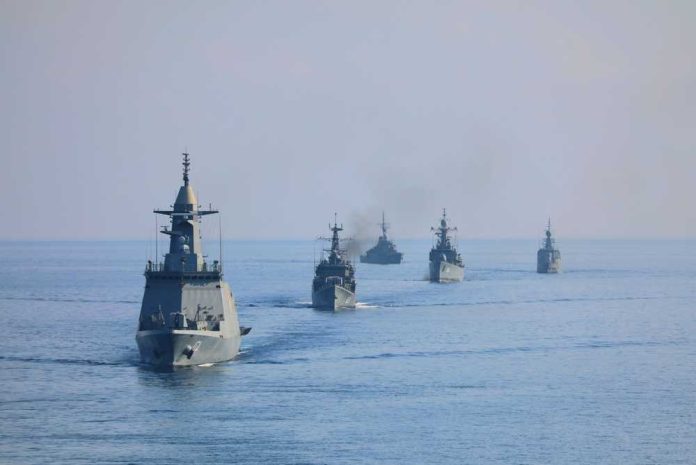
China just deployed more than 110 warships along a critical Pacific boundary — the most ever recorded — while quietly testing drone systems designed to make U.S. aircraft carriers obsolete.
At a Glance
- China set a new record in July 2026 by deploying 110-plus naval and coast guard vessels along the First Island Chain — the highest count Taiwan has ever publicly disclosed.
- China is testing a new “mini drone carrier” ship that launches unmanned helicopters, part of a broader push to replace costly crewed aircraft with swarms of cheap, expendable drones.
- China’s military strategy pairs drone swarms with carrier-killer missiles and submarines, all aimed at keeping U.S. carrier strike groups out of the western Pacific.
- Analysts warn the drone threat is real and growing, but note that none of China’s swarm tactics have been tested in actual combat.
A Record Fleet on Taiwan’s Doorstep
In July 2026, Taiwan’s National Security Bureau Director-General Tsai Ming-yen confirmed that China had stationed more than 110 People’s Liberation Army Navy and coast guard vessels across the East China Sea, Taiwan Strait, and South China Sea — the highest daily count Taiwan has ever disclosed. No military drills were formally announced. The ships simply appeared, spread across waters running from Japan through Taiwan to the Philippines.
The First Island Chain is the string of islands — Japan, Okinawa, Taiwan, and the northern Philippines — that forms a natural barrier between China and the open Pacific. Whoever controls those waters controls access to the region. China’s record fleet deployment signals that Beijing is actively working to dominate that zone, not just patrol it.
China’s Drone Carrier Strategy
At the same time, China is developing new tools to extend its reach without risking pilots or expensive warships. In late 2025, footage aired on China’s state military channel showed the AR-500CJ unmanned helicopter operating from a newly revealed vessel — effectively a small drone carrier. The ship was built at a Chinese shipyard and launched in 2022. Defense analysts described the test as a meaningful step in China’s push to deploy drone swarms from sea-based platforms.
China’s broader anti-access strategy — known in defense circles as area-denial — relies on three main tools: drones, missiles, and submarines. Carrier-killing ballistic missiles like the DF-21D and DF-26 are built to strike moving ships hundreds of miles away. Combine those with drone swarms launched from small carriers and submarines lurking beneath the surface, and the goal becomes clear: make it too dangerous for U.S. carrier strike groups to operate anywhere near Taiwan.
Drone Swarms: Real Threat or Overhyped?
China has conducted real tests. In early 2026, Chinese researchers demonstrated a coordinated “kill web” involving aerial, surface, and underwater drones working together. A People’s Liberation Army drone swarm system called Atlas can deploy 48 drones from a single launcher, with each command system controlling up to 96 at once. China also tested its L30 unmanned surface vessel swarm off the coast of Guangdong Province, showing autonomous patrol and interception capability.
But analysts at the Center for Naval Analyses, a federally funded research group, note that China’s drone swarm concepts are still being developed and refined — and have never been used in actual combat. The U.S. Navy is not standing still either. Both nations are spending billions on artificial intelligence-guided drones. China’s carriers, meanwhile, are venturing farther from home: in 2025, the Liaoning and Shandong operated outside the First Island Chain for a combined 58 days, up from 32 days the year before. That is real progress — but it is also still short of a proven wartime capability. The gap between testing and fighting is wide, and no one yet knows how these systems will perform when lives are on the line.
Sources:
19fortyfive.com, asiatimes.com, visiontimes.com, modeldiplomat.com, youtube.com, scmp.com, easternherald.com, geosirius.ifz.ru, maritime-executive.com, csis.org, geostrategy.org.uk, thedefensepost.com, cimsec.org, armyrecognition.com, kstatelibraries.pressbooks.pub, facebook.com, cna.org, militarymachine.com, nowpattern.com, breakingdefense.com, gatestoneinstitute.org, understandingwar.org, etd.ceu.edu