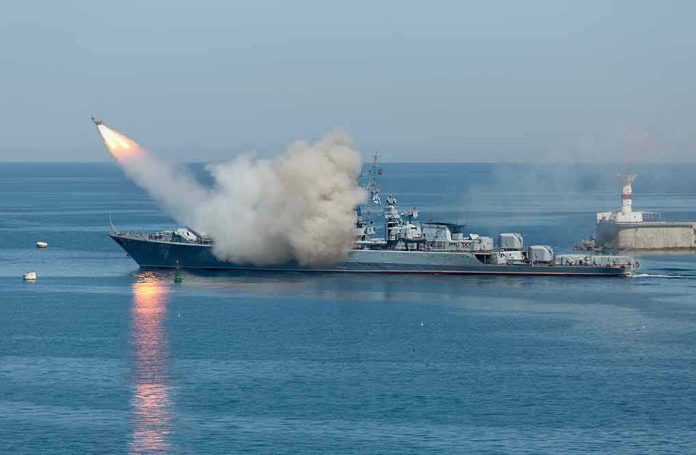
The latest U.S. strikes on nearly a hundred Iranian targets show how a single attack on a commercial ship can drag the whole region closer to a wider war while ordinary people watch a key global trade route turn into a battlefield.
Story Snapshot
- U.S. Central Command says it has carried out a third round of strikes on Iranian military sites tied to attacks on commercial vessels near the Strait of Hormuz.
- American forces hit about 90 targets, including air defense systems, coastal radar, missile and drone storage, and small boats, aiming to protect civilian mariners and shipping.
- Iran’s forces have struck tankers and other commercial ships and claimed at times to close the Strait of Hormuz, while the U.S. insists the waterway must stay open to all vessels.
- These back-and-forth attacks fit a years-long pattern that worries people across the political spectrum who see a distant fight risking higher costs at home and more power for unelected “elites.”
What CENTCOM Says Happened
U.S. Central Command (CENTCOM) reports that American forces have completed another round of strikes against Iran, focused on military targets along Iran’s coastline near the Strait of Hormuz. The latest operation hit roughly 90 Iranian targets, including air defense systems, coastal surveillance gear, missile and drone storage sites, naval assets, and logistics facilities. CENTCOM says these strikes are meant to “degrade Iran’s ability to attack commercial shipping and innocent civilian mariners” moving through the strait, which carries a large share of the world’s traded oil.
These attacks follow earlier U.S. strikes the night before, when CENTCOM says forces hit over 80 Iranian military targets tied to recent attacks on three commercial vessels transiting the Strait of Hormuz. U.S. forces reportedly targeted Iranian air defenses, command networks, coastal radar, anti-ship missile sites, and more than 60 small boats used by Iran’s Islamic Revolutionary Guard Corps. The command describes Iran’s actions against the tankers as “unwarranted aggression” that broke a fragile ceasefire and threatened freedom of navigation in a waterway vital to global trade.
Iran’s Attacks on Commercial Shipping
According to CENTCOM and international reporting, the latest U.S. strikes were triggered by Iranian attacks on multiple commercial vessels, including tankers flagged to the Marshall Islands, Saudi Arabia, and Liberia. In one case, U.S. officials say an Iranian drone hit a cargo ship in or near the Strait of Hormuz, setting it ablaze and forcing emergency responses. Other reports describe missiles and drones fired at three oil tankers, which the U.S. calls “wholly unacceptable” attacks on innocent crew members working in international waters.
Iran’s government and the Islamic Revolutionary Guard Corps have answered U.S. actions with their own strikes on U.S. bases and allied countries in the Gulf. Iranian media and officials also claim the right to control or even close the Strait of Hormuz, arguing they are responding to American interference and broken ceasefire terms. This back-and-forth has left shipping firms and sailors caught in the middle, as they try to move oil and goods through a narrow chokepoint that can be blocked or made dangerous with very little warning.
Who Controls the Strait of Hormuz?
U.S. Central Command has pushed back hard on Iran’s claim to control the strait, saying the Strait of Hormuz “is open to all vessels” and does not belong to any single country. American officials frame their strikes as necessary to defend global freedom of navigation, arguing that if Iran can shut down or threaten this route, it would give a hostile armed group huge leverage over energy prices and the world economy. Iran, by contrast, insists it has the right to respond to what it calls U.S. violations of a recent memorandum and ceasefire.
For Americans watching from home, this raises old fears on both the left and the right. Many conservatives see years of “globalist” policies that tied U.S. prosperity to distant shipping lanes now forcing American troops into yet another fight, while costs like fuel and groceries remain high. Many liberals worry that “America First” talk still ends in overseas strikes that risk more conflict and weaken social spending at home. Both sides increasingly share the sense that major decisions about war and peace are made far from public view by a small group of military, corporate, and political elites.
A Pattern of Escalation and Public Frustration
Analysts note that this crisis fits a familiar pattern: attacks on commercial ships in the Strait of Hormuz lead to U.S. retaliatory strikes, which then prompt Iranian counterattacks, all within a contested legal and political gray zone. Since 2019, most serious clashes between the U.S. and Iran have started with incidents at sea, yet ordinary citizens in both countries rarely see clear evidence or full legal explanations for each step. In this case, CENTCOM’s statements describe “retaliatory strikes” and “self-defense,” but there has been no public release of a detailed legal memo spelling out the international law basis.
U.S. STRIKES IRANIAN TARGETS AFTER IRGC FIRES ON VESSEL
Axios is reporting that the U-S military is striking Iranian targets in the Strait of Hormuz region in response to the Islamic Revolutionary Guard Corps' firing on a vessel.
The report says the ship was fired upon.. just…
— Worldwide News Network (@WorldwideNNX) July 11, 2026
Some shipping attacks are confirmed only through official military statements and limited video clips, which can deepen public distrust in an era of misinformation. People who already feel that Washington’s leaders care more about elections, lobbyists, and defense contracts than about the daily struggle of families see another distant fight where they bear the risks but have little voice. For many Americans, the battle over the Strait of Hormuz has become another symbol of a federal government that reacts to crises but rarely addresses the deeper problems of energy dependence, economic inequality, and endless low-level wars.
Sources:
facebook.com, cbsnews.com, centcom.mil, instagram.com, crisisgroup.org, congress.gov, thehill.com