
California is now openly inviting 16‑year‑old citizens and green card holders to help run its elections, putting teenagers who cannot legally vote at the heart of the voting process.
Story Snapshot
- State officials are asking high schools to recruit students as young as 16 to work inside polling places.
- Eligible teens include both United States citizens and lawful permanent residents, who themselves cannot vote in state or federal races.
- California law already allows green card holders and high school students to serve as poll workers under adult supervision.
- These teens can help issue ballots, check in voters, and assist with voting equipment, raising trust questions across the political spectrum.
California Expands Student Roles in Election Operations
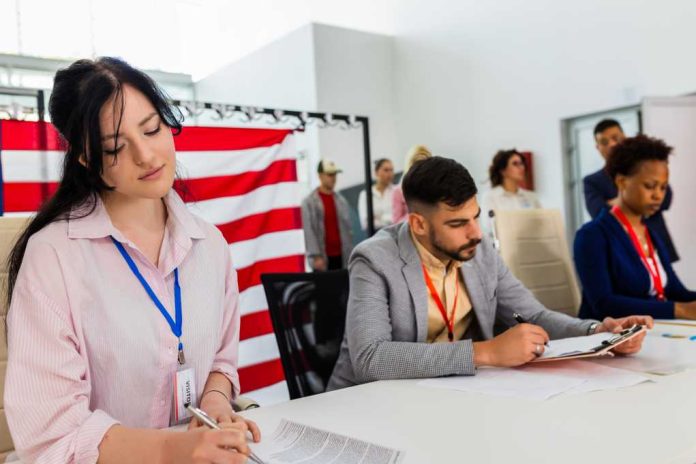
California’s Secretary of State and top education official have sent a letter asking public schools to help find teenagers to work at polling places in the November 2026 election. The letter, as described by reporting, says high school students can serve as poll workers if they are at least 16 years old, maintain a 2.5 grade point average, and are either United States citizens or lawful permanent residents. This means some students who are not yet voters themselves will still help manage the voting process for adults.
California Is Actively Recruiting Noncitizen Teenagers to Serve as Poll Workers in Elections | Jim Hᴏft, The Gateway Pundit
California has once again ignited concerns over election integrity after revelations that the state is recruiting noncitizen teenagers to work inside… https://t.co/JjcLN5Oc6a pic.twitter.com/YOYUSAMKrk
— Owen Gregorian (@OwenGregorian) July 11, 2026
California law already allows up to five high school students per precinct to serve as poll workers under direct adult supervision. The law treats student poll working as a civic learning experience, and schools are encouraged to excuse students from class for this duty. At the same time, the call to recruit teenagers is part of a larger push to fill thousands of poll worker slots statewide, as counties struggle to staff long election days with enough trained adults to run voting locations smoothly.
Noncitizen Teen Poll Workers: What the Law Actually Allows
Under current California rules, poll workers do not all have to be eligible voters. State guidance says a poll worker may be either a United States citizen or a legal permanent resident, which usually means a green card holder. Fact sheets from community groups explain that, since the mid‑2010s, lawful permanent residents have been allowed to serve as poll workers, first as high school students and then more broadly. These residents cannot vote in state or federal elections, but they can help administer them as workers.
County election offices across California now advertise poll worker jobs to citizens and legal permanent residents alike. Los Angeles County, Alameda County, and Kings County all list green card holders as eligible election workers alongside registered voters. High school programs, like one at La Jolla High School, repeat the Secretary of State’s rules: student poll workers must be either United States citizens or legal permanent residents, at least 16, in good academic standing, and willing to attend training. These public materials confirm that noncitizen teens who are lawful permanent residents can serve at polling places.
What Teen Poll Workers Actually Do at the Polls
County election offices describe poll workers as the people who handle almost every step of in‑person voting. Poll worker manuals say they set up polling sites, check in voters, issue and receive ballots, assist voters with equipment, and help close the location at night. Student poll workers are assigned under adult poll workers, but they may still assist with these core tasks as part of the team. In practice, that can mean a 16‑year‑old green card holder helps hand a ballot to a voter and operates the check‑in table.
Supporters say this system helps counties cover long hours and improves language support for diverse communities. Many recruitment pages stress the need for bilingual workers who can explain voting instructions in Spanish, Tagalog, and other languages. Critics, however, worry that allowing noncitizens to touch ballots and equipment could weaken public trust, even if those workers follow strict training and do not decide who is allowed to vote. Those concerns feed into larger fears about whether the election system is being guarded carefully enough.
Broader Debate Over Noncitizens and Election Integrity
Across the country, claims that noncitizens are deeply involved in elections—whether by voting, registering, or working the polls—have become a regular flash point. Careful reviews by groups like the Center for Election Innovation and Research and the Brennan Center for Justice find that actual noncitizen voting is extremely rare and usually linked to confusion or clerical error, not large‑scale plots. A Heritage Foundation summary and other studies agree that suspected noncitizen voting typically amounts to a tiny fraction of total ballots.
Still, the idea of noncitizen teenagers inside polling places hits a nerve for many Americans. Conservatives see it as one more way the political class plays with the rules of voting while ignoring crime, inflation, and border security. Liberals worry that constant fraud claims are used to justify strict rules that can make it harder for poor and minority citizens to vote. Both sides share a deeper anger that government leaders seem more focused on managing optics than fixing real problems in the system.
Why This Matters for Public Trust in a Failing System
For many voters, the core issue is not whether these teen poll workers follow the law, but whether the people in charge are listening to public concerns. When California quietly widens who can help run elections, without a clear public debate, it reinforces the feeling that decisions are made by insiders for insiders. People on the right and left already suspect that “deep state” bureaucrats see ordinary citizens as background noise, not partners, in self‑government.
California’s move shows how small rule changes can feed big doubts. Allowing lawful permanent resident teenagers at the polls is legal and documented, yet many will still ask why noncitizens have their hands on the machinery of voting at all. In an era when faith in institutions is near a low, every new tweak to election rules needs plain, honest explanation. Without that, even minor changes look like part of a larger pattern: a distant government changing the system while the American Dream slips further out of reach.
Sources:
thegatewaypundit.com, knightcolumbia.org, facebook.com, instagram.com, sos.ca.gov, lajollahigh.sandiegounified.org, ajsocal.org, justice.gov, nationalpopularvote.com, cato.org