
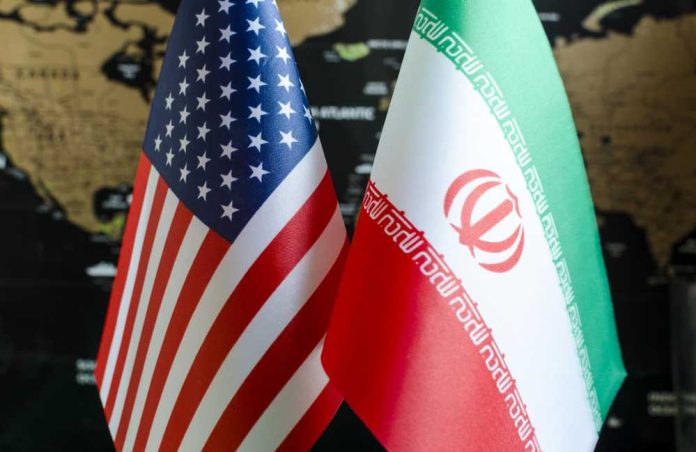
A new U.S.–Iran deal promises “permanent” peace while letting Tehran keep its nuclear program running and unlocking huge cash flows.
Story Snapshot
- The 14-point memorandum ends fighting now but delays hard nuclear decisions for later talks.
- Iran gets oil waivers, access to frozen assets, and a planned $300 billion development plan.
- The United States pledges to lift its naval blockade and pull forces back from Iran’s neighborhood.
- Key nuclear questions and terror support are pushed into a 60‑day negotiation window.
What the 14-Point Deal Actually Does
The new 14-point memorandum of understanding between the United States and Iran is written as a quick way to stop the shooting and reopen the Strait of Hormuz, not as a full peace treaty. The text says both sides and their allies will “immediately and permanently” end military operations on all fronts, including Lebanon, and will stop threatening or using force against one another.[6] It also commits Washington and Tehran to reach a final deal within 60 days, with an option to extend that deadline by mutual consent.[6]
For many Americans, the first question is what the United States gives up on day one. The document says the United States will start removing its naval blockade as soon as the memorandum is signed and must fully end it within 30 days.[6] It also vows to withdraw U.S. forces from areas close to Iran within 30 days after a final deal is reached.[6] That means Iran gets relief from military pressure right away, while U.S. leverage later rests mostly on promises, not on force in place.
Massive Economic Rewards for Tehran
The text offers Iran sweeping economic relief the moment the ink is dry. The memorandum says the United States will work with regional partners to create a reconstruction and development plan for Iran worth at least $300 billion in financing.[6] Media summaries add that Iran will be able to resume oil exports, receive waivers on energy sanctions, and regain access to frozen funds during the 60-day talks, including tens of billions of dollars that had been locked abroad.[7]
From a conservative view, that raises a basic fairness issue. Washington is promising to end all forms of sanctions against Iran on a schedule that will be fixed only in the later final deal.[6] In plain language, the hardest part for Tehran—giving up nuclear leverage and changing its regional behavior—comes later, while the easiest part for Washington—lifting sanctions and letting money and oil flow—begins now. This front-loading of benefits looks a lot like past “frameworks” that rewarded bad actors upfront and hoped for better behavior later.[7]
The Nuclear Question Kicked Down the Road
Supporters of the memorandum stress that Iran again says it will never produce nuclear weapons, and that future negotiations will address enriched uranium, inspections, and technical limits.[7] That sounds strong at first glance. But the same text also states that the fate of enriched materials and other nuclear issues will be handled only in the final agreement, while Iran keeps its current nuclear program in place until that deal is reached.[1] In other words, Tehran gets cash and trade while its centrifuges keep spinning.
News reports before the signing described talks over how long Iran would pause enrichment and at what level, with ideas ranging from five to twenty years, but those details are not in the public memorandum itself.[3] Analysts who have studied the ceasefire pattern between the United States and Iran warn that such deals often defer the toughest fights and can turn into open-ended pauses instead of real rollbacks.[16] For Americans who remember the problems with the Iran nuclear deal a decade ago, that mix of big promises and fuzzy enforcement will sound very familiar.
Why This Matters for U.S. Security and Pocketbooks
The White House and many media outlets stress that reopening the Strait of Hormuz and easing the war risk should help bring down global oil prices and, with them, gas prices at U.S. pumps.[1] Families who have watched energy costs soar since the last round of Middle East chaos will welcome any relief. But that short-term gain comes with long-term risk if Iran uses new oil money and freed assets to support militant proxies or to advance its nuclear work under the cover of “civilian” activity.
🛑 Vance says Israel mistrusts US over US-Iran memorandum
🛑 US Vice President Vance accused Israeli officials of showing "strange panic" and "hysteria" over a US-Iran memorandum of understanding, saying Israel lacks trust in the United States. Israeli politicians across…
— jck✨ (@Alea_) June 18, 2026
Conservative analysts also point out what is missing from the 14 points. The memorandum says nothing about Iran’s missile program or its backing for groups that target Israel and other U.S. partners.[15] It focuses instead on ending this particular war, reopening shipping lanes, and building an economic package. Experts describe the whole structure as a ceasefire framework and economic stabilizer, not a final settlement.[20] That means American voters must see this not as “peace in our time,” but as a risky pause that depends on the trustworthiness of a regime that has spent decades chanting “Death to America.”
Yair Pinto and Mati Shoshani) breaks down the freshly signed US-Iran Memorandum of Understanding (a temporary ceasefire agreement) and how Iran is already claiming total victory while Israel views it as dangerous.
Key Points Covered
Iran’s Reaction (Boasting Victory):
Iran’s…
— Holyhead Chronicles (@Holyhead12345) June 18, 2026
Sources:
[1] Web – The 5 passages of the US-Iran peace deal that worry critics the most: …
[3] YouTube – CNN obtains US-Iran draft agreement: What its 14 points reveal
[6] YouTube – US-Iran ceasefire terms released after deal officially signed
[7] Web – Iran media publish purported details of Iran-US draft agreement
[15] Web – 2026 Iran war ceasefire – Wikipedia
[16] YouTube – Ceasefire, Sanctions Relief And More | Firstpost Live
[20] Web – Walking a Tightrope: Scenarios for Iran–US Confrontation