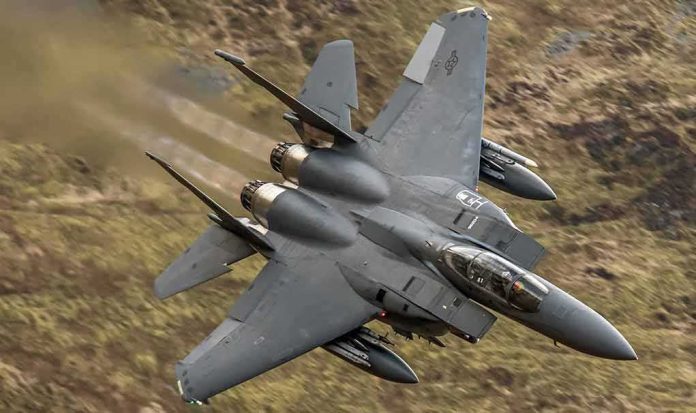
A U.S. F‑15E Strike Eagle worth tens of millions of dollars was reportedly brought down over Iran by a shoulder‑fired missile that costs a tiny fraction of that price—using technology U.S. officials say may trace back to China.
Story Snapshot
- U.S. officials told reporters the F‑15E was likely downed by a Chinese‑made shoulder‑launched missile fired by Iranian forces.[1][2][3]
- Reporting also points to a Chinese long‑range radar allegedly helping Iran spot advanced American jets deep inside its airspace.[1][2][3]
- China publicly denies providing weapons to any side in the conflict, and U.S. officials have not released hard evidence to the public.[1]
- The incident underscores how cheaper foreign weapons can threaten U.S. airpower while Washington pours billions into high‑end systems.
What U.S. Officials Say Happened Over Iran
According to multiple reports summarizing interviews with unnamed U.S. officials, investigators now believe the F‑15E Strike Eagle shot down over southwestern Iran in April was “likely” hit by a Chinese‑made shoulder‑fired missile operated by Iranian forces.[1][2][3] These officials described the suspected weapon as a man‑portable air defense system about seven feet long and weighing around 40 pounds, small enough for a ground team to carry yet powerful enough to destroy a frontline American strike fighter.[1]
Reports based on the same intelligence assessment say the aircraft, flying a deep‑strike mission over Iran’s mountainous southwest, was probably ambushed at relatively low altitude where such man‑portable systems are most effective.[1][4] U.S. sources quoted in foreign and American media consistently use cautious language—“likely,” “probable,” and “most likely weapon used”—signaling a strong but not yet public, forensic confirmation of the missile’s origin, model, or transfer pathway into Iran.[1][2][3]
The Alleged Chinese Radar Link and Beijing’s Denial
Alongside the missile claim, U.S. officials told reporters that Iran may have been using a Chinese‑made YLC‑8B long‑range radar system capable of detecting low‑observable or “stealth” aircraft to cue its defenses.[1][2][3][4] Reporting says this radar was provided to Tehran in the early stages of the war and could help track advanced American and Israeli jets at long range, even if it cannot directly guide a missile to impact.[1][2][4]
U.S. officials quoted in these reports emphasize that any Chinese assistance did not decisively change the overall balance of power in the conflict, describing the support as limited in operational impact.[2] Chinese diplomats, for their part, have rejected the accusations as “baseless,” stating that China has not provided weapons to any party in the fighting.[1] Iran has not publicly confirmed using Chinese‑origin systems to down the jet, leaving the public debate dependent on selectively released U.S. intelligence claims.
Why This Incident Feeds U.S. Distrust in Government and Elites
Many Americans on both the right and the left will see this story as another sign that the people in charge are playing a dangerous global game while ordinary citizens pay the price. A single shoulder‑launched missile—possibly supplied through opaque arms deals between authoritarian states—can erase a multi‑million‑dollar jet and threaten American aircrews, even as Washington spends hundreds of billions on defense budgets each year.[1][2] That mismatch fuels questions about whether policymakers are truly managing risk wisely.
Conservatives frustrated with decades of global entanglements may view the shootdown as proof that U.S. leaders failed to maintain unquestioned air superiority while pouring resources into foreign conflicts instead of border security or domestic priorities. Liberals who worry about militarization and inequality may see another example of elite decision‑makers committing lives and treasure overseas without clear accountability when things go wrong. In both cases, the common thread is mistrust: Americans suspect that key decisions and intelligence assessments happen behind closed doors, beyond meaningful public scrutiny.
Escalating Great‑Power Shadows: Iran, China, and U.S. Vulnerability
The suspected Chinese role in Iran’s air defenses highlights how great‑power competition increasingly plays out through proxy partners and technology transfers rather than open battlefield clashes.[1][2][3] If Chinese radar and missiles—or even just Chinese designs—helped Iran target an American jet, that would show how Beijing can challenge U.S. power indirectly while publicly denying involvement and avoiding direct confrontation with Washington.[1][2]
A new report has reignited debate over China's role in the recent US-Iran conflict. Acc 2 NBC News, investigators examining the loss of a US F-15E Strike Eagle over southwestern Iran believe the aircraft may have been hit by a Chinese-made MANPADS missile.https://t.co/es5iDSrQv2
— radhyka 🌎🍀 (@radhyka) June 1, 2026
For citizens watching from home, the pattern looks familiar: rival powers maneuver in the shadows while official statements stay vague, and neither party in Washington fully explains the risks, costs, and end goals. The fact that officials speak anonymously and use cautious language, while media outlets recycle the same intelligence‑based talking points, fits a broader trend where the public is asked to trust assessments it cannot independently verify.[1][2][3] That dynamic deepens the sense that a small circle of insiders—the so‑called “deep state” and global elites—manage war and peace without real transparency.
Sources:
[1] Web – US Officials Suspect Iran Used Chinese Missile To Bring Down F-15E …
[2] Web – Chinese-made shoulder-fired missile reportedly shot down F-15 …
[3] Web – Chinese Missile Likely Downed US F-15 Fighter Jet In Iran: Report
[4] Web – Report: Chinese-made missile likely downed US F-15 in Iran